


Page 44 - Gear Technology Solutions
P. 44
For  explanation  purposes,  the  ring  gear  has  only  one  tooth  which  is  curved
                   and has a spiral angle. In order to show the Ease-Off deviation amounts on a
                   flat plane, the principle of the projection plane is introduced. As a projection
                   plane, an axis section plane is used where the tooth corner points of the teeth
                   are radially projected onto the section plane. The red square in Figure 2 repre-
                   sents the gear tooth with heel, toe, top and root. This projection plane is now
                   used to draw the Ease-Off deviations as a third dimension. If both mating bevel
                   gears have conjugate manufacturing data, then the Ease-Off graphic has no
                   deviations in ordinate direction. Also, if the pinion flanks and the gear flanks
                   have spiral angle errors of equal amounts, the Ease-Off graphic will not show
                   any  deviation.  Although  the  individual  gears  are  considered  incorrect  in  this
                   case, they will roll conjugate with each other, which subsequently leads to an
                   Ease-Off without any ordinate values. In case of length and profile crowning,
                   circular deviations will be visible in the third-dimension direction. It cannot be
                   determined in the Ease-Off graphic if the crowning was applied to the pinion or
                   to the gear, or if part of the crowning was applied to the pinion and another
                   part was applied to the gear.


                   3.3  Different Types of Crowning

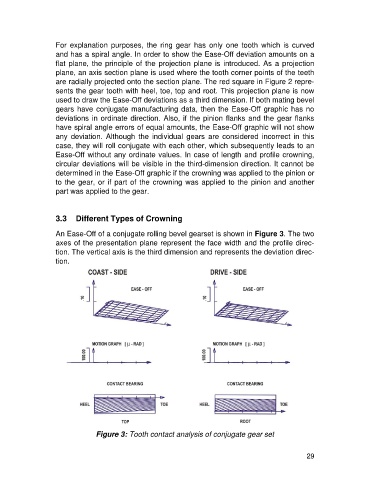
                   An Ease-Off of a conjugate rolling bevel gearset is shown in Figure 3. The two
                   axes of the presentation plane represent the face width and the profile direc-
                   tion. The vertical axis is the third dimension and represents the deviation direc-
                   tion.


                                 Figure 3: Tooth contact analysis of conjugate gear set


                                                                                                      29

