


Page 399 - Gear Technology Solutions
P. 399
with certain small differences. Those differences are, for example, the ratio be-
                   tween the two mating gear members which is realized with different combina-
                   tions of the pinion tooth number and the gear tooth number. Another potential
                   parameter which can differ between the members of the part family is the hy-
                   poid offset which in turn causes the pinion spiral angles to be different for each
                   different offset, even though the spiral angle of the ring gears is identical. In
                   some cases, certain optimizations to the contact geometry have been applied
                   in order to adjust particular members of the part family to different duty cycles
                   or application requirements.


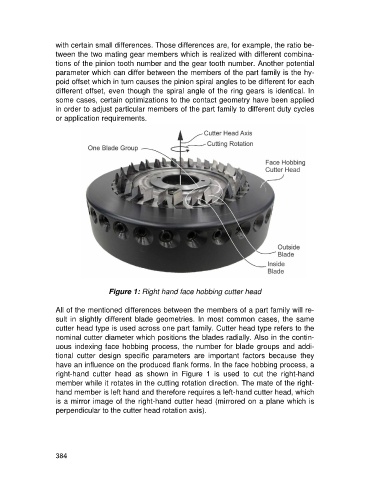
                                     Figure 1: Right hand face hobbing cutter head

                   All of the mentioned differences between the members of a part family will re-
                   sult in  slightly  different blade geometries. In most  common  cases, the same
                   cutter head type is used across one part family. Cutter head type refers to the
                   nominal cutter diameter which positions the blades radially. Also in the contin-
                   uous indexing face hobbing process, the number for blade groups and addi-
                   tional  cutter  design  specific  parameters  are  important  factors  because  they
                   have an influence on the produced flank forms. In the face hobbing process, a
                   right-hand  cutter  head  as  shown  in  Figure  1  is  used  to  cut  the  right-hand
                   member while it rotates in the cutting rotation direction. The mate of the right-
                   hand member is left hand and therefore requires a left-hand cutter head, which
                   is a mirror image of the right-hand cutter head (mirrored on a plane which is
                   perpendicular to the cutter head rotation axis).


                   384

