


Page 371 - Gear Technology Solutions
P. 371
“inch²” is used, even if the surface evaluation is done in metric units, like in the
                   present case.

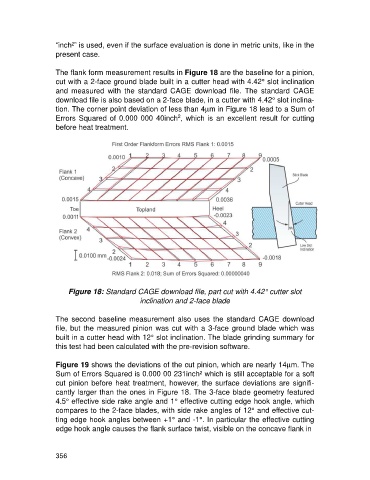
                   The flank form measurement results in Figure 18 are the baseline for a pinion,
                   cut with a 2-face ground blade built in a cutter head with 4.42° slot inclination
                   and  measured  with  the  standard  CAGE  download  file.  The  standard  CAGE
                   download file is also based on a 2-face blade, in a cutter with 4.42° slot inclina-
                   tion. The corner point deviation of less than 4mm in Figure 18 lead to a Sum of
                                                            2
                   Errors Squared of 0.000 000 40inch , which is an excellent result for cutting
                   before heat treatment.


                        Figure 18: Standard CAGE download file, part cut with 4.42° cutter slot
                                               inclination and 2-face blade

                   The second baseline measurement  also uses the standard  CAGE download
                   file, but the measured pinion was cut with a 3-face ground blade which was
                   built in a cutter head with 12° slot inclination. The blade grinding summary for
                   this test had been calculated with the pre-revision software.

                   Figure 19 shows the deviations of the cut pinion, which are nearly 14mm. The
                   Sum of Errors Squared is 0.000 00 231inch² which is still acceptable for a soft
                   cut pinion before heat treatment, however, the surface deviations are signifi-
                   cantly larger than the ones in Figure 18. The 3-face blade geometry featured
                   4.5° effective side rake angle and 1° effective cutting edge hook angle, which
                   compares to the 2-face blades, with side rake angles of 12° and effective cut-
                   ting edge hook angles between +1° and -1°. In particular the effective cutting
                   edge hook angle causes the flank surface twist, visible on the concave flank in


                   356

