


Page 359 - Gear Technology Solutions
P. 359
In order to obtain the effective angles, the relationship between the cutting ve-
                   locity vector (Figure 3) and the blade coordinate system in Figure 4 has to be
                   considered. The blade side rake angle shown in Figure 4 is equal to the effec-
                   tive side rake angle, if the indicated cutting direction is equal to the x-axis of
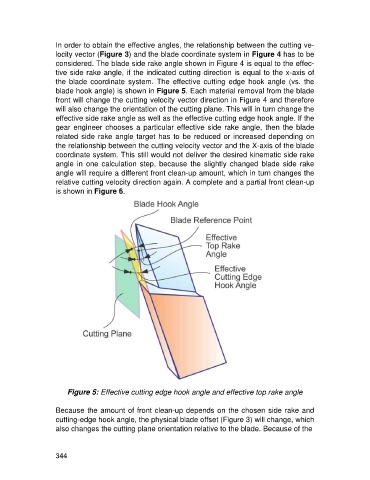
                   the  blade  coordinate  system.  The  effective  cutting  edge  hook  angle  (vs.  the
                   blade hook angle) is shown in Figure 5. Each material removal from the blade
                   front will change the cutting velocity vector direction in Figure 4 and therefore
                   will also change the orientation of the cutting plane. This will in turn change the
                   effective side rake angle as well as the effective cutting edge hook angle. If the
                   gear engineer chooses a  particular effective side  rake  angle,  then  the blade
                   related side rake angle target has to be reduced or increased depending on
                   the relationship between the cutting velocity vector and the X-axis of the blade
                   coordinate system. This still would not deliver the desired kinematic side rake
                   angle  in  one  calculation  step,  because  the  slightly  changed  blade  side  rake
                   angle will require a different front clean-up amount, which in turn changes the
                   relative cutting velocity direction again. A complete and a partial front clean-up
                   is shown in Figure 6.


                       Figure 5: Effective cutting edge hook angle and effective top rake angle

                   Because the amount of front clean-up depends on the chosen side rake and
                   cutting-edge hook angle, the physical blade offset (Figure 3) will change, which
                   also changes the cutting plane orientation relative to the blade. Because of the


                   344

