


Page 356 - Gear Technology Solutions
P. 356
26       Three-Face Blade Technology


                   26.1  Three-Face vs. Two-Face

                   In  order  to  utilize  the  full  potential  of  3-face  ground  and  all-around  coated
                   blades the cutter head slot inclination of 4.42° as it is used in the Pentac®-FH
                   cutter system is not sufficient. In case of 2-face ground blades, the front face
                   remains untouched during the re-sharpening, only pressure angle and  clear-
                   ance side of the blade are reground. The front face of 2-face blades is parallel
                   to  the  blade  shank  and  has  a  permanent  coating.  After  re-sharpening,  the
                   blades are ready to be built in the cutter head.

                   If two-face blades should be all around coated, then it is necessary to strip the
                   coating  from  the  front  face  before  re-coating.  The  reason  is  the  continuous
                   buildup of coating layers on the front face if no stripping between coatings oc-
                   curs. It is possible to strip the front face coating chemically before every re-
                   coating, but this would involve additional cost and results in a degradation of
                   the  carbide  under  the  repeatedly  stripped  surface.  In  case  of  a  desired  all-
                   around coating, it is recommended to convert the two-face blades to three-face
                   blades and grind the front face of the blades also in order to remove the previ-
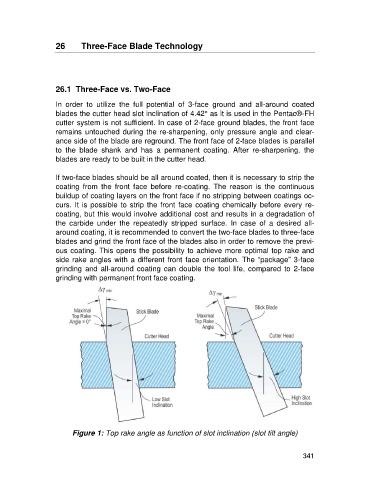
                   ous coating. This opens the possibility to achieve more optimal top rake and
                   side rake angles with a different front face orientation. The “package” 3-face
                   grinding  and  all-around  coating  can  double  the  tool  life,  compared  to  2-face
                   grinding with permanent front face coating.


                         Figure 1: Top rake angle as function of slot inclination (slot tilt angle)


                                                                                                     341

