


Page 344 - Gear Technology Solutions
P. 344
The  standard  face  hobbing  pinion  plunge  vector  feed  as  shown  in  Figure  3  in
                   combination with an optimized plunge roll position shows the optimal cutting re-
                   sults.  A  blade  geometry  optimization  might  be  necessary  if  there  are  witness
                   marks of chip dragging on the convex flank surfaces, but no scratches on the side
                   reliefs of the pressure angle side on the inside blades. The recommendation is to
                   use a larger blade top width and increase the side relief angle of the inside blades
                   by up to 4° [2]


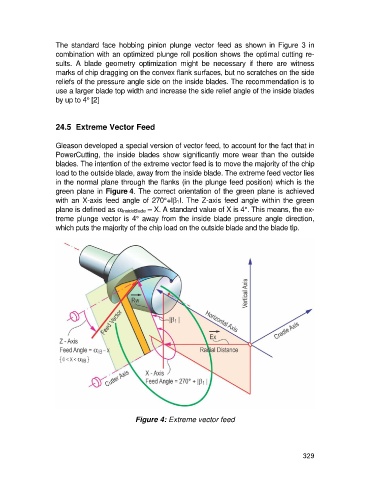
                   24.5  Extreme Vector Feed

                   Gleason developed a special version of vector feed, to account for the fact that in
                   PowerCutting,  the  inside  blades  show  significantly  more  wear  than  the  outside
                   blades. The intention of the extreme vector feed is to move the majority of the chip
                   load to the outside blade, away from the inside blade. The extreme feed vector lies
                   in the normal plane through the flanks (in the plunge feed position) which is the
                   green plane in Figure 4. The correct orientation of the green plane is achieved
                   with an  X-axis feed  angle of 270°+Ib 1I. The Z-axis  feed  angle  within  the green
                   plane is defined as a InsideBlade – X. A standard value of X is 4°. This means, the ex-
                   treme  plunge  vector is 4° away from the inside  blade pressure  angle direction,
                   which puts the majority of the chip load on the outside blade and the blade tip.


                                              Figure 4: Extreme vector feed


                                                                                                     329

