


Page 308 - Gear Technology Solutions
P. 308
Blad e
                   22       Blade Definitions Manual


                   22.1  Introduction to the Manual

                   This  chapter  is  a  manual  with  all  the  common  geometric  features  of  stick
                   blades for the cutting of bevel gears. The nomenclature for the different cutting
                   blade  features  has  often  not  been  clear.  Gear  engineers  helped  themselves
                   out of this conflict and created definitions that seemed to apply to the particular
                   geometrical feature. The introduction of a new and very innovative three-face
                   blade  geometry  deemed  the  requirement  to  establish  or  re-establish  correct
                   and common terms and definitions. When the three-face blade grinding sum-
                   mary  was  developed,  Gleason  engineers  from  Research  &  Development  as
                   well as from Application Engineering studied existing Gleason literature in or-
                   der to find the correct vocabulary as it has been defined in the past. Only in a
                   few cases, new definitions had to be adopted. Those were  cases where the
                   function of a certain feature had not been known in the past, or it was neglect-
                   ed because its influence was not clear, and the older two-face geometry had
                   no freedom to change it. One example is the term “Kinematic Top Rake Veloci-
                   ty Angle”. The existence of this angle was neglected until the three-face soft-
                   ware was developed in 2009.


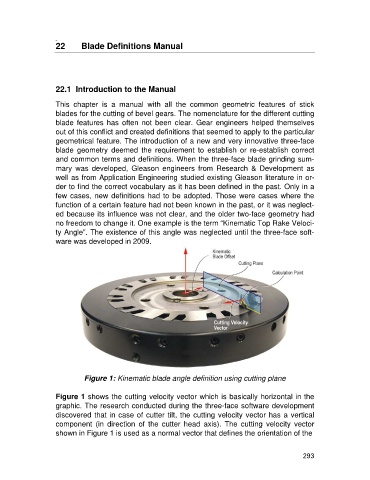
                             Figure 1: Kinematic blade angle definition using cutting plane

                   Figure 1 shows the cutting velocity vector which is basically horizontal in the
                   graphic. The research conducted during the three-face software development
                   discovered that in case of cutter tilt, the cutting velocity vector has a vertical
                   component  (in  direction  of  the  cutter  head  axis).  The  cutting  velocity  vector
                   shown in Figure 1 is used as a normal vector that defines the orientation of the


                                                                                                     293

