


Page 298 - Gear Technology Solutions
P. 298
The shaft angle allows a negative tolerance which will reduce the backlash by
                   40% of the backlash range and a positive tolerance which increases the back-
                   lash by 60% of the backlash range.

                   Miter spiral bevel gears are similar to straight bevel gears because the back-
                   lash setting should also be done by increasing or reducing the pinion cone (P)
                   and the gear cone (G) by equal amounts. Shifting only one  of both will also
                   change the contact pattern position. In case of small changes within the toler-
                   ances shown in Table 4 (equal for pinion cone P and gear cone G) the contact
                   movements are within permissible limits.


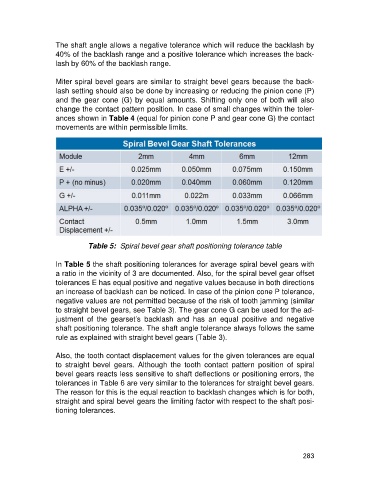
                              Table 5:  Spiral bevel gear shaft positioning tolerance table

                   In Table 5 the shaft positioning tolerances for average spiral bevel gears with
                   a ratio in the vicinity of 3 are documented. Also, for the spiral bevel gear offset
                   tolerances E has equal positive and negative values because in both directions
                   an increase of backlash can be noticed. In case of the pinion cone P tolerance,
                   negative values are not permitted because of the risk of tooth jamming (similar
                   to straight bevel gears, see Table 3). The gear cone G can be used for the ad-
                   justment  of  the  gearset’s  backlash  and  has  an  equal  positive  and  negative
                   shaft positioning tolerance. The shaft angle tolerance always follows the same
                   rule as explained with straight bevel gears (Table 3).

                   Also, the tooth contact displacement values for the given tolerances are equal
                   to  straight  bevel  gears.  Although  the  tooth  contact  pattern  position  of  spiral
                   bevel gears reacts less sensitive to shaft deflections or positioning errors, the
                   tolerances in Table 6 are very similar to the tolerances for straight bevel gears.
                   The reason for this is the equal reaction to backlash changes which is for both,
                   straight and spiral bevel gears the limiting factor with respect to the shaft posi-
                   tioning tolerances.


                                                                                                     283

