


Page 22 - Gear Technology Solutions
P. 22
1.8  Tooth Thickness Calculation and Output

                   International and national standards offer strength calculations for spiral bevel
                   and  straight  bevel gears, most  of  which  use the tooth  thickness  at  the  pitch
                   point.  The  pitch  point  or  calculation  point  is  defined  in  the  standards  at  the
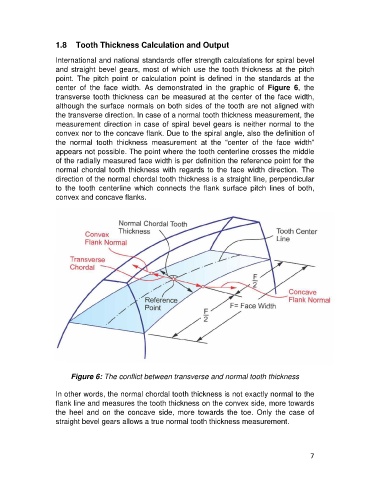
                   center  of  the  face  width.  As  demonstrated  in  the  graphic  of  Figure  6,  the
                   transverse tooth thickness can be  measured at the center of the face width,
                   although the surface normals on both sides of the tooth are not aligned with
                   the transverse direction. In case of a normal tooth thickness measurement, the
                   measurement direction in case of spiral bevel gears is neither normal to the
                   convex nor to the concave flank. Due to the spiral angle, also the definition of
                   the  normal  tooth  thickness  measurement  at  the  “center  of  the  face  width”
                   appears not possible. The point where the tooth centerline crosses the middle
                   of the radially measured face width is per definition the reference point for the
                   normal  chordal  tooth  thickness  with  regards  to  the  face  width  direction.  The
                   direction of the normal chordal tooth thickness is a straight line, perpendicular
                   to  the  tooth  centerline  which  connects  the  flank  surface  pitch  lines  of  both,
                   convex and concave flanks.


                        Figure 6: The conflict between transverse and normal tooth thickness

                   In other words, the normal chordal tooth thickness is not exactly normal to the
                   flank line and measures the tooth thickness on the convex side, more towards
                   the  heel  and  on  the  concave  side,  more  towards  the  toe.  Only  the  case  of
                   straight bevel gears allows a true normal tooth thickness measurement.


                                                                                                        7

