


Page 181 - Gear Technology Solutions
P. 181
A graphic of the orientation between grinding wheel and Curvic coupling mem-
                   bers is shown in Figure 15. In this graphic the outside of the grinding wheel
                   profile forms two concave flanks of the member with hourglass shaped teeth
                   (left).  In  one  revolution  all  teeth  are  finish  ground.  The  opposite  member  is
                   ground with the inside profile of a different grinding wheel and forms two con-
                   vex flanks simultaneously which results in hourglass shaped teeth (right graph-
                   ic in Figure 15). The wheel point diameter between the left and right graphic is
                   adjusted such that either a full-face width contact or a located contact pattern
                   is  achieved.  Profile  crowning  is  also  possible  by  dressing  a  curved  grinding
                   wheel profile.

                   It  becomes clear that  a single tooth  and slot centering force  requires a high
                   accuracy of the tooth surfaces. In  many steam turbines more than 50 rotors
                   are bolted together to one unit. The radial centering has to provide low radial
                   runout, but also the axial runout has to be in the fractional micron range in or-
                   der to minimize the unbalancing of a long rotor unit. There is software available
                   which  uses  spacing  measurement  results  from  coordinate  measuring  ma-
                   chines to calculate an optimal timing between two rotors. If all rotors are as-
                   sembled with their optimal Curvic coupling timing, then the overall runout and
                   unbalance of a long rotor unit can be minimized to sustain highest rotational
                   speeds.

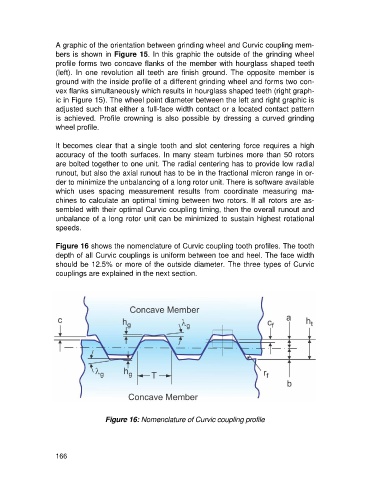
                   Figure 16 shows the nomenclature of Curvic coupling tooth profiles. The tooth
                   depth of all Curvic couplings is uniform between toe and heel. The face width
                   should be 12.5% or more of the outside diameter. The three types of Curvic
                   couplings are explained in the next section.


                                    Figure 16: Nomenclature of Curvic coupling profile


                   166

