


Page 177 - Gear Technology Solutions
P. 177
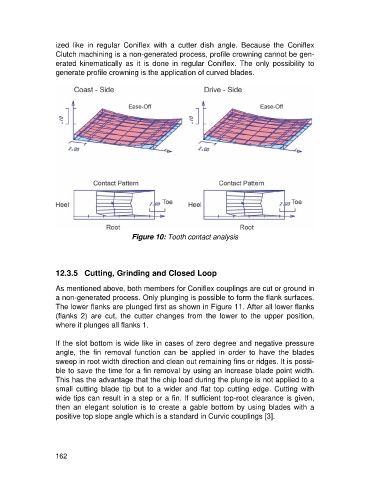
ized  like  in  regular  Coniflex  with  a  cutter  dish  angle.  Because  the  Coniflex
                   Clutch machining is a non-generated process, profile crowning cannot be gen-
                   erated  kinematically  as  it  is  done  in  regular  Coniflex.  The  only  possibility  to
                   generate profile crowning is the application of curved blades.


                                             Figure 10: Tooth contact analysis


                   12.3.5   Cutting, Grinding and Closed Loop

                   As mentioned above, both members for Coniflex couplings are cut or ground in
                   a non-generated process. Only plunging is possible to form the flank surfaces.
                   The lower flanks are plunged first as shown in Figure 11. After all lower flanks
                   (flanks  2)  are  cut,  the  cutter  changes  from  the  lower  to  the  upper  position,
                   where it plunges all flanks 1.

                   If the slot bottom is wide like in cases of zero degree and negative pressure
                   angle,  the  fin  removal  function  can  be  applied  in  order  to  have  the  blades
                   sweep in root width direction and clean out remaining fins or ridges. It is possi-
                   ble to save the time for a fin removal by using an increase blade point width.
                   This has the advantage that the chip load during the plunge is not applied to a
                   small  cutting  blade  tip  but  to  a  wider  and  flat  top  cutting  edge.  Cutting  with
                   wide tips can result in a step or a fin. If sufficient top-root clearance is given,
                   then  an  elegant  solution  is  to  create  a  gable  bottom  by  using  blades  with  a
                   positive top slope angle which is a standard in Curvic couplings [3].


                   162

