


Page 63 - Gear Technology Solutions
P. 63
direction. The motion graph has, next to some numerical entrance and exit var-
                   iation, zero motion error. The contact bearings show line contact within the en-
                   tire working area. The coast side contact ends at a toe root undercut (section
                   e).

                   Each spiral bevel gearset with uniform tooth depth has a conjugate base de-
                   sign. This applies to all face hobbed and some face milled gearsets. Hypoid
                   gearsets can only be conjugate with a non-generated gear that meshes with a
                   generated pinion. For the calculation and manufacturing process, the hyperbol-
                   ic pitch elements are calculated for the gear first. Then a suitable blade profile
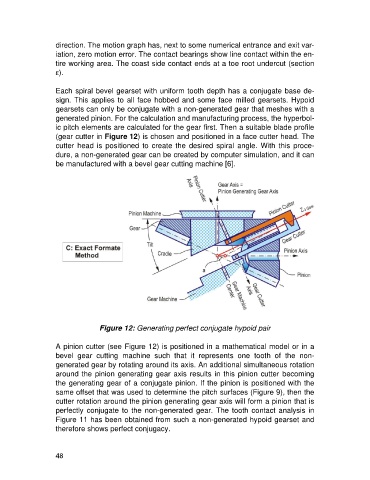
                   (gear cutter in Figure 12) is chosen and positioned in a face cutter head. The
                   cutter head is positioned  to  create the  desired spiral  angle.  With this  proce-
                   dure, a non-generated gear can be created by computer simulation, and it can
                   be manufactured with a bevel gear cutting machine [6].


                                  Figure 12: Generating perfect conjugate hypoid pair

                   A pinion cutter (see Figure 12) is positioned in a mathematical model or in a
                   bevel  gear  cutting  machine  such  that  it  represents  one  tooth  of  the  non-
                   generated gear by rotating around its axis. An additional simultaneous rotation
                   around the pinion generating gear axis results in this pinion cutter becoming
                   the generating gear of a conjugate pinion. If the pinion is positioned with the
                   same offset that was used to determine the pitch surfaces (Figure 9), then the
                   cutter rotation around the pinion generating gear axis will form a pinion that is
                   perfectly conjugate to the  non-generated gear.  The tooth contact analysis  in
                   Figure 11 has been obtained from such a non-generated hypoid gearset and
                   therefore shows perfect conjugacy.


                   48

