


Page 64 - Gear Technology Solutions
P. 64
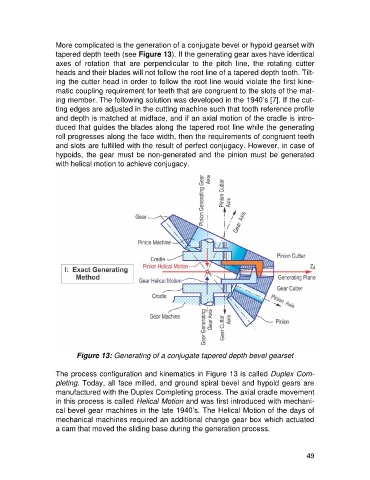
More complicated is the generation of a conjugate bevel or hypoid gearset with
                   tapered depth teeth (see Figure 13). If the generating gear axes have identical
                   axes  of  rotation  that  are  perpendicular  to  the  pitch  line,  the  rotating  cutter
                   heads and their blades will not follow the root line of a tapered depth tooth. Tilt-
                   ing the cutter head in order to follow the root line would violate the first kine-
                   matic coupling requirement for teeth that are congruent to the slots of the mat-
                   ing member. The following solution was developed in the 1940’s [7]. If the cut-
                   ting edges are adjusted in the cutting machine such that tooth reference profile
                   and depth is matched at midface, and if an axial motion of the cradle is intro-
                   duced that guides the blades along the tapered root line while the generating
                   roll progresses along the face width, then the requirements of congruent teeth
                   and slots are fulfilled with the result of perfect conjugacy. However, in case of
                   hypoids, the gear must be non-generated and the pinion must be generated
                   with helical motion to achieve conjugacy.


                          Figure 13: Generating of a conjugate tapered depth bevel gearset

                   The process configuration and kinematics in Figure 13 is called Duplex Com-
                   pleting. Today, all face milled, and ground spiral bevel and hypoid gears are
                   manufactured with the Duplex Completing process. The axial cradle movement
                   in this process is called Helical Motion and was first introduced with mechani-
                   cal bevel gear machines in the late 1940’s. The Helical Motion of the days of
                   mechanical machines required an additional change gear box which actuated
                   a cam that moved the sliding base during the generation process.


                                                                                                      49

