


Page 215 - Gear Technology Solutions
P. 215
15.4  Example

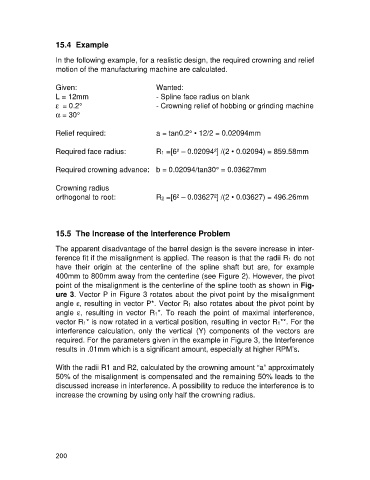
                   In the following example, for a realistic design, the required crowning and relief
                   motion of the manufacturing machine are calculated.

                   Given:                            Wanted:
                   L = 12mm                          - Spline face radius on blank
                      =

                   e  0.2°                           - Crowning relief of hobbing or grinding machine
                   a = 30°

                   Relief required:                  a = tan0.2° • 12/2 = 0.02094mm

                   Required face radius:             R1 =[6² – 0.02094²] /(2 • 0.02094) = 859.58mm

                   Required crowning advance:  b = 0.02094/tan30° = 0.03627mm

                   Crowning radius
                   orthogonal to root:               R2 =[6² – 0.03627²] /(2 • 0.03627) = 496.26mm


                   15.5  The Increase of the Interference Problem

                   The apparent disadvantage of the barrel design is the severe increase in inter-
                   ference fit if the misalignment is applied. The reason is that the radii R1 do not
                   have  their  origin  at  the  centerline  of  the  spline  shaft  but  are,  for  example
                   400mm to 800mm away from the centerline (see Figure 2). However, the pivot
                   point of the misalignment is the centerline of the spline tooth as shown in Fig-
                   ure 3. Vector P in Figure 3 rotates about the pivot point by the misalignment
                   angle e resulting in vector P*. Vector R1 also rotates about the pivot point by
                           ,
                   angle  e  resulting  in  vector  R1*.  To  reach  the  point  of  maximal  interference,
                            ,
                   vector R1* is now rotated in a vertical position, resulting in vector R1**. For the
                   interference  calculation,  only  the  vertical  (Y)  components  of  the  vectors  are
                   required. For the parameters given in the example in Figure 3, the Interference
                   results in .01mm which is a significant amount, especially at higher RPM’s.

                   With the radii R1 and R2, calculated by the crowning amount “a” approximately
                   50% of the misalignment is compensated and the remaining 50% leads to the
                   discussed increase in interference. A possibility to reduce the interference is to
                   increase the crowning by using only half the crowning radius.


                   200

