


Page 155 - Gear Technology Solutions
P. 155
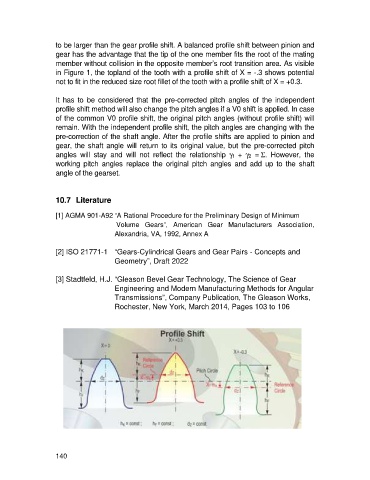
to be larger than the gear profile shift. A balanced profile shift between pinion and
                   gear has the advantage that the tip of the one member fits the root of the mating
                   member without collision in the opposite member’s root transition area. As visible
                   in Figure 1, the topland of the tooth with a profile shift of X = -.3 shows potential
                   not to fit in the reduced size root fillet of the tooth with a profile shift of X = +0.3.

                   It  has  to  be  considered  that  the  pre-corrected  pitch  angles  of  the  independent
                   profile shift method will also change the pitch angles if a V0 shift is applied. In case
                   of the common V0 profile shift, the original pitch angles (without profile shift) will
                   remain. With the independent profile shift, the pitch angles are changing with the
                   pre-correction of the shaft angle. After the profile shifts are applied to pinion and
                   gear, the shaft angle will return to  its original value, but the pre-corrected  pitch
                                                                                         .

                   angles  will  stay  and  will  not  reflect  the  relationship  g 1  +  g 2  = SHowever,  the
                   working  pitch  angles  replace  the  original  pitch  angles  and  add  up  to  the  shaft
                   angle of the gearset.


                   10.7  Literature

                   [1] AGMA 901-A92 “A Rational Procedure for the Preliminary Design of Minimum
                                        Volume  Gears”,  American  Gear  Manufacturers  Association,
                                       Alexandria, VA, 1992, Annex A

                   [2] ISO 21771-1  “Gears-Cylindrical Gears and Gear Pairs - Concepts and
                                       Geometry”, Draft 2022

                   [3] Stadtfeld, H.J. “Gleason Bevel Gear Technology, The Science of Gear
                                       Engineering  and Modern Manufacturing Methods for Angular
                                       Transmissions”, Company Publication, The Gleason Works,
                                       Rochester, New York, March 2014, Pages 103 to 106


                   140

