


Page 169 - Gear Technology Solutions
P. 169
possible, because of the fact that both coupling and clutch members are facing
                   each other without any possibility of a defined relative motion between them.

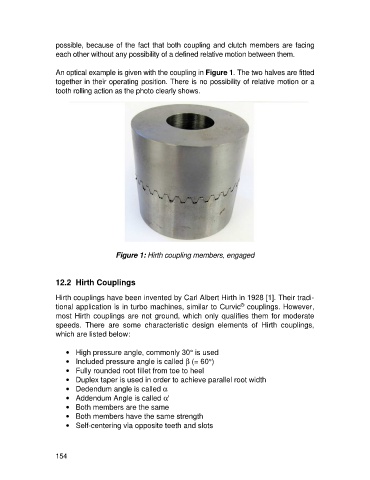
                   An optical example is given with the coupling in Figure 1. The two halves are fitted
                   together in their operating position. There is no possibility of relative motion or a
                   tooth rolling action as the photo clearly shows.


                                       Figure 1: Hirth coupling members, engaged


                   12.2  Hirth Couplings

                   Hirth couplings have been invented by Carl Albert Hirth in 1928 [1]. Their tradi-
                                                                                 ®
                   tional application is in turbo machines, similar to Curvic  couplings. However,
                   most Hirth couplings are not ground, which only qualifies them for moderate
                   speeds.  There  are  some  characteristic  design  elements  of  Hirth  couplings,
                   which are listed below:


                       · High pressure angle, commonly 30° is used

                       · Included pressure angle is called b (= 60°)

                       · Fully rounded root fillet from toe to heel

                       · Duplex taper is used in order to achieve parallel root width

                       · Dedendum angle is called a

                       · Addendum Angle is called a'
                       · Both members are the same

                       · Both members have the same strength

                       · Self-centering via opposite teeth and slots


                   154

